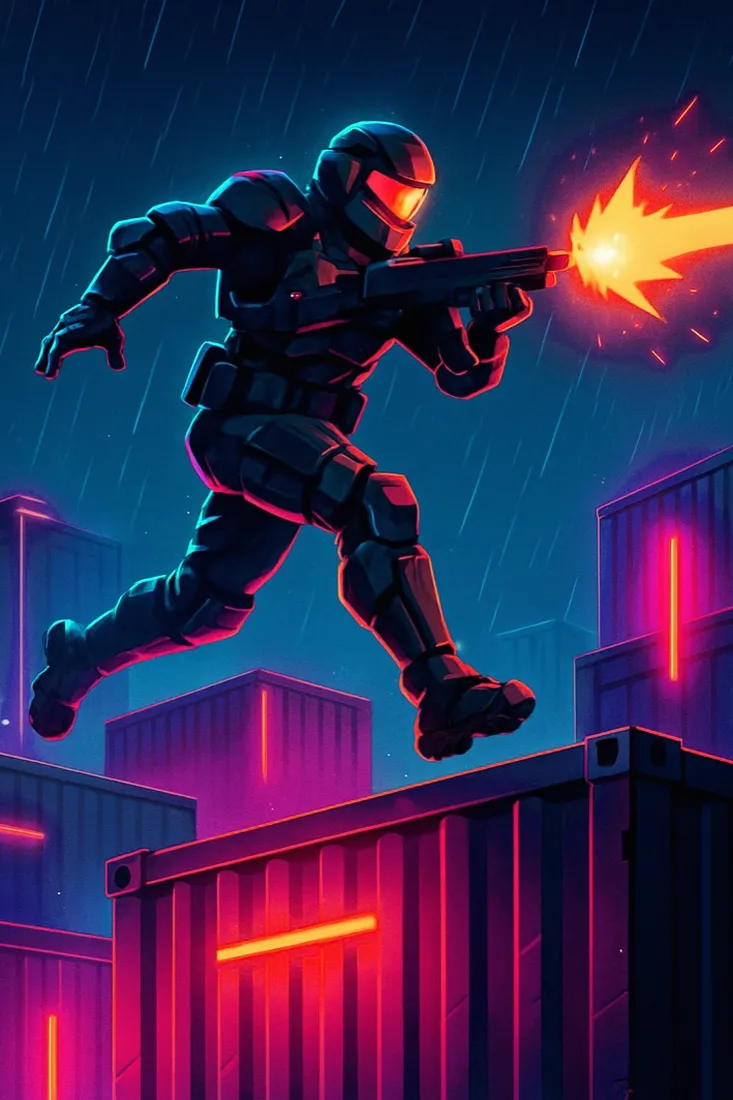
Krunker wastes no time. The official site loads the client right in the tab, a match is already running behind the menu, and within a moment or two you have a rifle and a target. There is no story to sit through and no lobby to wait in. Everything about the game is tuned around the next few seconds, and the next few seconds are almost always a firefight.
Then, usually inside your first handful of deaths, Krunker shows you how much there is to learn. Someone slides around a corner far faster than you thought the game allowed and drops you before your crosshair moves. That is not a glitch; it is the movement system working as designed. Learning it is what turns Krunker from a cute browser shooter into the game we kept reopening on long winter evenings.
Triggerman, Hunter and the class you should marry
Each class pairs a primary weapon with a way of moving and fighting. Triggerman carries an assault rifle and is the sensible first pick, with reasonable range and forgiving recoil. Hunter swaps that for a sniper rifle and turns each engagement into one tense decision. Run N Gun brings a submachine gun and a noticeably quicker stride for players who prefer to fight at arm’s length.
The roster stretches well past those three into shotguns, revolvers, heavy machine guns and rockets, and every class keeps a sidearm for emergencies. Our firmest advice is to stay with one class for a full week. Hopping between them every match hides what you are actually improving at, and Krunker pays out for depth far more generously than it does for variety.
Momentum is the real ammunition
Crouch while running and you slide. Jump at the right moment out of that slide and you keep your speed. String those inputs together along walls, ramps and rails and you can cross a lane before a defender has finished turning. None of this is spelled out in a menu. You pick it up by watching the people who beat you and by repeating the same jump in an empty map until your fingers stop arguing.
That learning curve is steep, and it is also why we score the controls so highly. Inputs feel immediate and exact, so every failed trick is clearly your mistake rather than the game’s. The payoff is worth the climb: the night a slide-hop finally lands and you arrive at a fight half a second early is the moment Krunker stops being a browser game and becomes a hobby.
An official rotation plus an endless shelf of player maps
The official modes cover arena staples. Free for All drops a handful of players onto a compact map with fast respawns, which makes it the ideal warm-up. Team Deathmatch splits the room into two sides, Hardpoint sends teams scrambling for a moving control zone, and Capture the Flag rewards whoever can run faster than the defence can react. A ranked option waits for players who want structured competition.
Past that sits the community. Krunker’s in-client browser lists thousands of player-made maps and modes, from parkour courses to infection-style rounds, and custom games let a group set its own rules. Some community maps are rough, a few are brilliant, and the parkour ones are quietly the best movement school in the game. Ten minutes on one before a session makes the official maps feel slower.
Skins, a busy market and a level playing field
Krunker has an in-game currency, a shop and a player market where cosmetic items change hands, and it is not shy about any of it. Across our weeks on a fresh account, none of that touched the fights. A weapon behaves the same whether it is plain or wearing an elaborate finish, so a free player is never outgunned by someone with a bigger wallet.
We still knocked a point off for noise. The menus lean on the shop and market more than we would like, and new players can feel nudged toward cosmetics before they have learned to aim. Our approach was to ignore that side completely for the first month. The game underneath is whole without it, and you will know what you actually want once you have found your class.
Krunker: week one in the arena
- Play Free for All as Triggerman for your first few sessions and focus only on keeping your crosshair at head height.
- Spend ten minutes on a parkour map practising the slide, then chaining a jump out of it without losing speed.
- Lower your mouse sensitivity until a full swipe across the pad turns you roughly half a circle; most new players start too high.
- Watch a match in spectate after a bad round and copy one route the top player used to reach the centre of the map.
- Try Hardpoint once you can hold your own, since fighting over a zone teaches positioning faster than chasing kills.
What we love
- From opening the tab to taking a first fight is measured in seconds, not minutes.
- Movement tech gives the game a skill ceiling that keeps rising every week you play.
- Community maps and custom games mean the evening never depends on the official rotation.
- Cosmetics never change how a weapon fires, so free players fight on equal terms.
What grates
- Menus push the shop and market harder than a newcomer needs.
- Experienced lobbies can feel brutal until your movement catches up.
- Busy maps ask more of an older laptop than the blocky look suggests.
Who Krunker is made for
Krunker is for players who enjoy getting measurably better at something. If you like the idea of practising a jump twenty times, choosing one class and learning it inside out, and judging your progress by how often you reach a fight first, nothing else on our rack rewards you as generously.
Krunker: final score
Krunker is the most complete quick-match shooter you can open in a browser. It is fast to start, exact to control, generous with community content and fair to players who never spend. The shop noise and a steep first fortnight hold it back from perfection, but no game on our rack gave us more good evenings, and none kept teaching us for as long.